Sunday, October 16, 2011

Elijah & Skilliam v Blackdown part 1


A month or so ago, I headed east to meet up with Elijah and Skilliam. They'd recently submitted their Rinse 17 mix CD and it was time for the sleevenotes. 

I''ve been talking, off and on, with the duo for three or more years now and have come to have immense respect for their vision, their work rate and how they go about things. Having hopped on a bus with no precise idea of where I would get off, luckily I found them waiting for me at a bus stop. We headed to Butterz HQ.

There'd been so much happen between that I felt not only did it need documenting but in some ways I felt it represented how grime as an entire scene had evolved in recent years. The resulting interview is the largest transcript I can ever remember doing in my entire journalism career... yes longer even than Loefah and Si Kryptic Minds.

So to celebrate the Rinse 17 CD and indeed the achievements of Elijah and Skilliam, I'm going to publish the transcript here in four parts, one a week until the CD is out. Each week will include some exclusive content. This week...

EXCLUSIVE DOWNLOAD: Elijah & Skilliam Live from Plug, Sheffield October 2011

And so, to the interview...

Elijah & Skilliam v Blackdown interview part 1

Martin I'm going to start right at the beginning, because we should have done this a long time ago. How did you two meet? And how do you know each other? Because it feels like - looking at that [Elijah’s wall covered in hundreds of photos and flyers] - that you've been mates for quite some time.

Skilliam University....You know what, I actually saw you before university one time - I was with one of my MCs, one of my old crew. He used to do videos at that time. I didn't say anything to you, because I was just with him, but he met you and that was it. And then we went to uni and I saw you walking around - it was like the first day I think, and obviously Dane was in my halls - and I was like "I know I've seen him before somewhere", and it clicked.

M When did you guys clock that you liked similar music?
Elijah It must have been pretty quickly... Well it was in the first few months of uni.

M So what times are we talking?

Elijah This was like 2005.

M And was it about grime then?

E Yeah, yeah.

M Good time to like grime!

E But then because we were… not isolated but I was in Hertfordshire, the Rinse stream had just started. I don't know how many people I knew were locking at the time - it wasn't many. So the only way I was hearing stuff was downloading it afterwards, and it wasn't even proper podcasts, it was people ripping it... Barefiles. People used to float about tapes - just exchange stuff.

M Literally “tapes!” Cassette tapes. Tape packs. You’re looking at me like I’m odd but certain generations won’t know what that is.

E Uni is liked a kind of closed community, isn't it?...

Sk ...It's like a little bubble. An obviously in Herfordshire, you can't go anywhere else apart from the campus.

E Yeah, all that stuff never really came to us, like raves and that - maybe Kano once in a year. When did Boy Betta Know come? in the second year?

Sk And Lethal B.

M But really, you would have to come into London to go to clubs?


E Yeah, just on the weekends when we were back we'd have Dirty Canvas  - which was still going at the time, and stuff like that. But I remember the first time we were hooking up was when I brought the decks up. I was like the only person on campus with decks.

M  It's a big investment when you're a student

E It wasn't even an investment - these were just some shit decks...  I still use it now. It was just something to do, I was just spending like 18 hours awake a day, you need something to do. There's nowhere to go. This thing about students sleeping all day, you don’t really do it do you?

Sk There's either nothing going on or there's always something going on.

E Yeah - "just come over for a mix quickly"

M We were talking before the tape was on about things being of their time and how quickly a time and place can pass and one of the things I only clocked later about uni that you definitely don't notice at the time is that you're in a community where everyone is your age. Hundreds of people who are exactly your age. As that’s time and a place, other phases of life  are not like that.... But then you're surrounded by people who might be like you.

E But we weren't, that's the thing. [Apart from] me and Skilliam, how many other people liked grime? We were still outcasts - the majority was like Friday night, put on a shit shirt and listen to Baywatch riddim. That kind of stuff is wicked, it's fun, but then we still liked our own kind of music from London.

M: What did the other black guys like? Did you have any black mates who liked grime?

E: There weren't a lot of black people in our year.

Sk The next year, people started coming through.

M Everybody who likes specialist music finds themselves a little bit isolated.

E Imagine here, we think it's bigger than it was. But when I got there, I though "oh right".

SK People know it, but - I don't know - they mature out of grime sort of. Everyone went into the RnB and hip hop sides of it. That's what happening at the raves. Djs: they all play RnB and hip hop & bashment. You don't really get grime in the clubs. Even on a Wednesday - nope.

E We went to uni early, before the funky thing popped off.

Sk When we started to do the radio show.

E Oh yeah, yeah.

M I think there were Funky guys in '05, but they were literally just playing American house.

E Straight up RnB and then there would maybe a couple of token grime records, “Hype Hype,” “Pow” if you’re lucky . In halls, I would walk past the kitchen, and I didn't really talk to [the other guys] for a while. I'd pop my head in and say "safe". One day I was just sitting around, and a guy just looked at me. "‘Safe’s’ a good thing right?” And I was like “wow”. And when you're here [east London], you think everyone knows things like that, like "Wha gwan?" Those are the things that I say that you think everyone in the whole country knows, but pretty much my  vision is different now, because most people don’t understand these things or know what grime is.

Sk You might even get people on Twitter saying "what does ‘safe’ mean?", and “teach me some East London slang!”

M That's something I definitely noticed, because I came to London and started working in places like Deuce magazine where I started writing about grime. It was in Hackney Wick and Stratford, and I definitely clocked that the MCs there had a world view that it was the ends. I asked if they had ever played in up north and they said "Yeah, we've played in Watford". I meant like Glasgow. And that was quite symptomatic of it being that world that they lived in,

E Yeah north to us is Tottenham. Their perspective of grime was Heat FM, and ours was Deja. Someone in south was On Top FM. And that's only in London.

M Or Raw Mission?

E Yeah. See how small it was? Though there were loads of stations over here [in east].

M I like each station basically being like a galaxy or universe in itself, but at certain points it must kick in in that decade that things could be recorded so that people can hear other stations outside of it’s radius.

E Most of them never crossed over.

SK: I used to go to online stations like Axe  and Heat as well, but you know get North MCs that go there, rather than cross over MCs.

M And I guess only certain MCs were big enough to go on multiple stations

E And the people who were listening to them online were still people from the ends, who knew the website. You think on occasion there might be one person listening in Canada. Now, you speak to people, and they've never been to England before, and they don't know anyone in England, but they know Rinse.

M So, you're at uni and you clock that you both like similar music. The normal thing is that everyone gets in to music, and if they really like it a lot, they start participating and getting involved. How did you find ways to participate? DJing originally? Buying records, I guess, but how did it develop from there?

SK I used to give Dane CDs as well.

E  There was no motive. We were just doing it. You know, did you talk to a person in a shop when you were buying this record? You just buy it because you like it. I used to listen to clips on the Rhythm Division Website, before I was buying records.

M Realplayer Clips!  I love that phasing effect that early file hosting had on dial up, I used miss it when I buy the actual record. Dubplate.net was the same. It was a like a phase, pulsing down and up sound

E People used to come round my halls and have a mix, chill out, like normal friends do innit. Everyone is going it because they enjoy it. The part where we started interacting with people is when we were did the blog.

M Did the blog come before being involved with grime forum, or did that come after?

E  Before, grime Forum started in 2008.

M When did you start the blog?

E Early 2007. That was because other people that I was reading just slowed up or stopped. I was still going to the nights, whereas they weren't.

M Always a good reason to start anything, really, is that you feel there is a need to do it and no one is doing. There is a hole, I should go into it. there's something missing - I should do it. And it's funny because lots of labels and DJs have come out of blogs, and in a way they probably shouldn't, but it's a good platform for getting yourself known, and working out what you like about music and sharing it.

E But that wasn't a motive. When I interviewed Maniac it wasn’t the intention to get songs. I did it because I wanted to hear what he had to say.

M Of course, and I wouldn't say otherwise, but its often the effect of it rather than the motive - a bonus effect.

E Its weird, if  I wasn't at uni at the time, then I wouldn't have had the free time to be listening to everything again, to write about it and all that kind of stuff. If I left school and went into a job I would just live a normal kind of life. There’s so many ways I would have not been on it…


M I remember a time when you said that you'd had a guy turn you down for a job because you mentioned the music in your CV.

E Yeah, that was the last job I did. I was applying for recruitment consultancy roles. I came back from uni, and he said I had the job on the Monday before I was supposed to start, but on Friday he called me up and said "bad news, this music thing. We looked at it on Google and we think it would be a conflict of interest. If you need to stay until eight o'clock, then you won't be able to do your radio show." He put all these stipulations on it. I thought “arrg, this is long.”

M  Did you believe him?

E I didn't question it, I just left it. I knew there would be a point where I'd just go "OK", and do it 100%, go full throttle. It was just odd that it happened. I was gearing myself up, I’d been to uni for three years and done a year of work experience. So I was gearing myself up to work - to be in a office and wear a suit. I was comfortable with that -  I think. It's not even that I was comfortable of it, I was capable of it. I still am now.

M You [Elijah] did marketing right?

E Yes

M What did you [Skilliam] do?

Sk Business Management

M You see, those aren't intrinsically bad things to have as a background for musical careers. They're both actually pretty useful things to have. They are kind of things that most musicians have to work out later, or pay someone to do it, rather than having a bit of a grounding in it.

I don't know if there was a tipping point for you [Skilliam] with DJing, often things can look like a tragedy but actually turn out to be one of the biggest opportunities of your life. Maybe you wouldn’t have had all you’ve done as Butterz if it wasn’t for that?

Sk It's all decisions. What actually got me started DJing was that I had a choice of two schools, and the one I went to they went to me: "You want to be a DJ?" - that's what got me into it. If I didn't go to that school...

M The school wanted you to be a  DJ?

Sk No, my friends, the MCs said “we need a DJ and we need you to be it.”

E That's how crews started when you're kids.

Sk Yeah, they named me and everything, saying "You're gonna be Skills!". That's how it went. If I went to the other school, none of this would have happened at all… well, I might have been.

M You don't know - I've definitely had that with people I've met. The difference here though is that's a decision that was a positive one, that you've gone to a school and good things have come out of it. But the weird one is when something bad happens to you, and actually it ended up being a really good thing. At the time you're thinking "I've got no job, it's a really bad thing".

E I think the economy thing in general - if it was pretty straight forward to get a job, we'd have got a job. Because you've been through the whole university process, its natural, and much easier to make a living. Its the next stage isn't it? You go to college, go to uni, you get a job.

M With me, I also didn't get a lot of jobs for a long time in music journalism. I only permanent job I had was the Deuce one and it was really badly paid. It was great - writing about Deuce magazine early grime, but every other job I didn't ever get. I think if I'd ever got one I wouldn't have had time to specialise. Those times were hard, and I was really, really poor for ages. But the people I met there are now my really good musical friends, and a really good investment that, at the time, looked like a total disaster.

E At the time you can only see the short term, but when you look back at it now...

M How long were you with  Grime Forum?

E The four people who started it were just on MSN having a conversation about RWD Forum. RWD had gone, it was useless, so imagine the place was everyone had been going for years, it had no news on there about grime for ages, so the site was useless. And then, they didn't bother having a forum. There was no place for grime anymore, so we kind of had a conversation. "Who can do that? - I can do that.", once everyone kind of clubbed together...

M And who were the people?

E There was the Hij guy - he already had the Grimepedia thing going on. Lemon, who's a technical guy. Aza-T who was doing podcasts at time, and me who was doing the blogging thing. There was probably a couple of other people that liked the idea, but didn't get into it heavy at the start, you know Hyperfrank was around. If I could find the first 10 members of the site that would be a good statistic. Even at the time I'd only met one of them personally, but when you see names online and on blogs, you feel like you know them

M The funny thing about grime and forums is that for a lot of while I think a lot of the MCs saw it as what they would call really neeky right? I learnt a lot about garage and grime through forums. Uptown forum I used to read a lot. RWD forum. Those two were my staples for finding out about Pay As U Go. People like Logan were being really aggressive on forums. A lot of MCs used to look down on forums, but now it's just normal that you would be on Facebook, Twitter or whatever.

Sk I think that they'll see someone criticising them and take it to heart so much.

E But that could be your only feedback though. Remember that if you didn't have your Twitter of people praising you, the 30 people who are responding to your video, or you wouldn't even have the YouTube video up there. Think of all these things that are there to give them a decent level of feedback [at that time].

M The thing is, it's not just that they weren't there, in the grime scene, they were used to the fact that if someone had said critical things to them and they were in their area, then they would go and do something about it. They would have a word saying "You can't say that to my face, this is what's going to happen", or things would get retracted.

Suddenly, things are being said by people they couldn't get at. I saw this with jungle guys before, they were used to a similar sort of thing. Normally you'd say something to his face, but then you online you couldn't get at these guys.

E I never thought of it that way.

M The grime forum was good though, important,  it kind of incubated a  lot of people who were into grime and kept things in one place. Did it have an influence on you guys? Was it useful.

Sk Yeah. We used to post our shows on grime forum. It was on the university radio station, that's when we would be like on Krush. That guy Geo.

M So how we get the link of you guys being on that station to Rinse? How did the link with Rinse come about.

E Scratcha. I knew him because I'd been interactive with producers who were making grime and stuff. It kind of goes around that there is a person that is doing interviews in grime. That kind of thing goes around. The explanation he gave me was that Rinse are looking for grime DJs, and where would you find a grime DJ at that time. It was 2008, and the funky thing was popping off. It was like, why in the hell would you start DJing grime in 2008, there's no reason - not to say there were no big tunes at the time - but there was nothing stand-out at the time that would make someone new go like "yeah, I want to be a grime DJ."

M It didn’t have the momentum of ’04. It wasn't flavour of the month

E The year after “Wearing My Rolex” came out

M It gave you an opportunity I guess. People who know about you now, probably don't appreciate... To me that seemed like a leap of faith by Rinse in a really good, positive way, because it's not like you walked into Rinse at the level you are now. So you definitively worked up the visibility and exposure you've got. So how did it feel, and how did it come about in being asked to join Rinse, or demo?

E We had done a guest demo thing and its weird… the whole grime DJ thing is the height of DJing in grime is playing on Rinse. So getting an opportunity was like "oh shit!". We had like two days to sort out tunes, and imagine I had never done a proper radio show. We were doing the uni radio show, but it's not the same. Me playing on Rinse was like “we need to step it up a level.” We got told on the Thursday night, but I remember where I was.... I was in my girlfriends house in Harrow. We did it on a Saturday 9 until 11 in November 2008

M So you didn't have to submit a tape or an example of what you’ve done before?

E No, just come and try. There was no-one on before or on afterwards, you remember?

Sk [Laughs] Yeah, we had to go and get the key!

M Was this the studio that was underground? Actually I know two old ones that were underground…

E The one in Bow. I remember asking for feedback and they were like "Yeah, soon." We never got the feedback. The feedback was “11-1?” It kind of never stopped, we do cover shows now all the time.

M You do put the time in.

E But then we are on on 1 till 3 am, and I think it's important. We value that slot like its 9-11, And I think they recognise that we treat the Thursday 1 till 3 like the prime EastEnders kind of slot.

M I think if you have that mentality in Rinse - that you treat every show as sacred - that they recognise it - I hope they do anyway.

E I assume they do because we're doing this [mix].

M Rinse also recognise when people put the grind in outside Rinse. By their contributions they give back to Rinse. You’re loyal to it but you've made something by yourselves rather than hoping they do the work for you.

E That was obvious from when we got there, because we didn't them and they didn't know us, we had no conversations. A lot of people that were there when we started, they've come through their  connections to them. We're just totally disconnected from everyone. He [Skilliam] knows Spyro.

Sk But I didn't get a bring in from Spyro...

M Spyro seems to know a lot of people, don't you think? Well DOK because he's related to him right…

Sk The youth clubs and stuff- he used to go everywhere. Even at the time he was one of the strongest DJs, and everyone knew about Spyro. He was on Flava.

E We knew about him.

M There are a few DJs on Rinse that can do things that other DJs can't, like mixing wise and he's definitely one of them. I think that it's like Spyro, Oneman and Youngsta. Youngsta for his accuracy. Spyro and Oneman have similar abilities to blend things forever really quickly. I don't know who else you guys would look to, technical DJ wise…

Sk EZ?

E Plastician- when he was Plastic Man. He still has the skills now, but I prefer the music he did when he was Plasticman. Our show was based on him. The way he does it, yeah, is that he has all these instrumentals and he used the vocals as the glue. He'll play like 10 instrumentals, and only play one strong vocal every 20 minutes. The vocal stand out so much that it makes you enjoy it 10 times more. The format of all the grime shows was like play a tune for 4 minutes - OK that's finished - play another one. You're fitting in all these vocals that weren't all that good anyway, off mixtapes… random. First hour would be vocals unmixed, then it would be instrumentals time.
 

M Do you remember the times before that where they were playing American RnB in those early sections?  Then Dizzee started making “You Were Always,” they started making their own version of RnB songs, and then it became mixtape era.

E So now when we got into Rinse, it wasn't our idea, but we wanted to run the mix all the way through, so every show sounds like a CD. You can take a show from 2009 and its going to feel like an album. So you could listen back a bit, which was always important, especially as we were on so late. If people were picking it up, they could listen to it in an afternoon.

M So this is what Dusk and I do. You have an arc to your show, a shape to the show. I think some DJs just get up there and play tunes, whereas we try to say that this tune can really fit here, and it sounds like you also do that.


E Because of the volume of the show we do as well, it's not straightforward to do it. We might get in there and start with tropical songs, like the ones from JME’s Project, so once you get started on a vibe...

Sk ... You can go from there.

E Yeah

M A starting point

E Yeah. Or, if we know we have a couple of new Trim vocals, and we have to play them the beginning, as they won't sit in the middle of a mix.


M And they can be quite strange tempos as well.

Sk And even the listenership as well. Being one o'clock in the morning. You have to catch those one o'clock people.

E Yeah, otherwise they kind of drop off. Never save a good tune until 02.55am!

M [Laughs] Yeah, I see what you mean. So you got on Rinse, and I definitely remember a point where you were like "we're starting a label". How did that crystallise? Because, you know, starting a label in an era when records don't sell anymore, CDs or digital or download or anything. Why? When? Who's idea was it?

E I don't think it was any one person’s idea. I wouldn't let anyone take credit. If I said it was me, he could say "no".

M A shared mind..

E Yeah, and the volume of tunes we were playing, especially with our format, where I'm listening to Vectra's show, and he would only get through 35 tunes, but because we were in a mix from 1-3am, we were getting through 60 tunes and then 90%  by talented guys were not coming out. People who are really highly rated today, like Terror Danjah, Swindle, D.O.K at that time had no outlet for their music.
 

M Terror was in that lull period wasn't he, after Aftershock and Flash and all that, but before Planet Mu.

E: It was a myth. No tunes came out.

---
The interview continues here: Part 2 of Elijah and Skilliam v Blackdown. Rinse 17 mixed by them is out November 121st.


Rinse 17 mixed by Elijah and Skilliam tracklist:

Royal-T – Orangeade VIP
D.O.K – East Coast
Swindle – Pineapple
P Money & Blacks – Boo You feat Slickman
Faze Miyake – Blackberry
Wiley – It’s Wiley (Royal-T Remix)
Mr Mitch – Centre Court
Rossi B & Luca – Lost in Limehouse
P Jam – Arizona Skyz
Terror Danjah – Full Attention feat Ruby Lee Ryder
Royal T – Royal Rumble
Spooky – Spartan (Terror Danjah Remix)
Teddy – Community Links
Swindle feat Terror Danjah, Rude Kid & Wizzy Wow – Tag
Bok Bok – Silo Pass
Royal T & Terror Danjah – Music Box
Trim – I Am (Preditah Remix)
Faze Miyake – Take Off
Swindle & Silkie – Unlimited
Treble Clef – Ghetto Kyote
S-X – Woooo (DJ Q Remix)
Royal T – Music Please (TRC Remix)
Terror Danjah – Air Bubble (Starkey Remix)
Starkey & P Money – Numb
TRC – Into Sync
Starkey & Trim – This Ain’t Me
Swindle – Mood Swings VIP


Tuesday, September 27, 2011

Unclassified: exclusive free new Dusk + Blackdown track


[Unclassified] by Adult Swim

18 free exclusive tracks, including an unreleased remix by myself and Dusk. Cop them here.

01. World On Mute – Ikonika
02. Kerpow – XXXY
03. Peaky – Untold
04. Pure Bristle – Geiom
05. Chrome – Ginz
06. Running from the Demons – Lukid
07. Knife & Gun – Geeneus feat. Riko, Wiley and Breeze (Dusk & Blackdown 2step mix feat. Farrah)
08. Golddigger – SBTRKT
09. Eris – Starkey
10. Murder Plaza – Actress
11. Hexagons – Zomby
12. Ikopol – Dauwd
13. Waiting For The Lights – Boxcutter
14. Give You Time – Babe Rainbow feat. Ashley Webber
15. Street Halo – Burial
16. Just Inside – Kode9
17. Blow Out the Candle – Pinch
18. R U Listening – Cooly G

Thursday, September 22, 2011

Rinse Sept


Me & Dusk were back on Rinse Thursday 22nd at 11pm

DOWNLOAD the audio here.


Tracklist:

Four Tet "Pyramid" [Text]
Actraiser "Kong Riddim" [unreleased]
Jook10 "Hazard" [We R Bass EP]
Beneath "Dilemma" [unreleased]
Zed Bias ft Serocee "Push My Button" [forthcoming TruThoughts]
Murdz86 "Funk on the Beach" [unreleased]
Sunday Roast "Save Our Soul"  [We R Bass EP]
Kon "TuЯnabout" [B YRSLF]
Mosca "Done Me Wrong" [Numbers]

Desto "Monsters About" [unreleased]
Visionist "Vixen" [unreleased]
Kidnap Kid "Taken" [unreleased]
Ms Dynamite "Neva Soft (Mike Delinquent Project remix)" [Relentless]
Tsunga "GeeSKay" [unreleased]
Horsepower "What We Do (original mix)" [Tempa]
Minerva "Oh My" [forthcoming Car Crash Set]

***Kuedo album showcase***

Kuedo "Visioning Shared Tomorrows" [forthcoming Planet Mu]
Kuedo "Ant City" [forthcoming Planet Mu]
Kuedo "Scissors" [forthcoming Planet Mu]
Kuedo "Salt Lake Cuts" [forthcoming Planet Mu]

DJ Rashad & Gant-Man "Heaven Sent [forthcoming Planet Mu]
Krampfhaft "Karl Sagan The Man" [forthcoming RWINA]
Cardopusher "We Want Ca$h feat. Sensational (Nehuen Remix)" [forthcoming]
The Two Fifteens "Atari Acid Den" [The Commute Vol. 1]
DJ Earl "Enlightenment [forthcoming Planet Mu]
Slick Shoota "POW Riddim 2011" [unreleased]

Roachee and Rudekid ft Rival and Stutta "Why" [forthcoming]
Goth Trad "Sublimation" [Deep Medi]
Footsie "Do You Get Me Boss" [BrainDeadEnt]
Mr Mitch "Salem" [unreleased]
Trim "Notice Now (Matt Wizard remix)" [unreleased]
Swindle "Spend Is Dough (Royal-T instrumental Remix) [unreleased]
Krampfhaft "Hyper Dreaming (Desto remix)" [unreleased]
Distal "Boss of the South" [Grizzly]
SP MC "Oh My Gosh" [Tempa]


 Thanks to everyone who was feeling the Sully & Unreleased Keysound show from last week. You can still download the audio for that.

Wednesday, September 14, 2011

OK tho...


Over at Pitchfork you can find my column on the incredible debut album from Kuedo, formerly known as Jamie Vex'd. Hear clips over at Mu. One of my albums of the year, no question.

I've enjoyed arguing debating with Jamie for years now, ever since the Bristol lot started commuting up to early days of Forward>>, though it's easier to do debate now without the Plastic People system in the background, as we used to. While we didn't use to agree (Vex'd = not my thing, sorry...), I always came away having learned something. This time, though far more amicable, was no exception.


Blackdown: Hey Jamie, so when we’ve talked occasionally over the last three or so years sometimes you’ve been writing music and sometimes you’ve not been. How did you come to decide “I’m going to write an album” now?

Kuedo: Well, without going into too many details, I guess there’s not been so much time to put towards an album because of upheavals and personal life over the last couple of years. But it quietened down and all the “other factors” in life began to subside somewhat and it gave me more time to work on music. And it was then I began writing an album: it had been something I wanted to do for the two years prior but there’d been some difficulties with other stuff, personal stuff. But I think it may be better to have done it later than have done it before because I’d gone through some phases in music that I think were good to get out before I settled into something, which is how I think I am now. It feels a bit more settled than it feels for a while, in terms of a bit more connected to what I’m really into.


B: Did you find that because the direction of the Vex’d stuff was so focused, that you had to spend time to be re-inspired so you weren’t still in the Vex’d headspace?


K: The thing is with that was that Vex’d was really an experiment and a project and it was a collaboration between two people. It had very narrow parameters and a lot of the musical characteristics were really built around Roly’s preferences. That’s not to negate my creative input but it did mean that I was writing within someone else’s sphere of preferences. And that became more the more we did it, with a familiar writing process. But when it came to me to be free from all of that it took some time for me to define my own musical language, myself, particularly for it to be authentically me, in terms of what I was really into and really saying something. Really tapping into what I’d been into and where I wanted to go. So I had to experiment a little before I found out what I should be doing.


B: Kode9’s talked a little about his headspace after dubstep, and to clumsily paraphrase it from memory, he described it as having fun getting lost, in an attempt to fall in love with new types of music whist not trying too hard to convince yourself that you are trying to fall in love again. Do you relate to any of that process?


K: Yeah I think it kinda happens cyclically. I think you commit yourself to a certain direction for a while, to explore a certain territory, to experiment and become confident in a certain territory. And then I think there’s a point that you express or say what you wanted to say. And at that point is a good point to let go of what felt familiar, and re-explore other stuff. You’re detaching what your usual anchors are and get lost a little bit. And then finding something new and recommitting to that as the new idea forms, with new forms, ideas, musical symbols, narrative you didn’t know existed or whatever you are discovering. And then settling in and making it your mission to go in a certain direction for a while. But if you just stay open then you end up adrift you have to commit at some point. But you can stay too committed – and this is why I feel some distance between some people I would have considered peers previously. I guess some people have this kind of commitment through thick or thin, no matter what. And no matter how they feel about it they’ll stay committed to a certain direction, for better or for worse. And that I can’t understand. If your inspiration’s gone, you can’t do anything for anyone.


B: I can think of a few people you and I both know who I’ve had discussions with about this and the crazy thing is that they seem to think that there’s still room for new in these templates or formats when there really hasn’t been any new ideas within that territory for quite some time. And when I put some distance between myself and them and listen to their music I don’t hear new ideas nor ideas better than the ones they came with before.


K: Old ideas are OK as long as they’re viewed with a kind of energy by the guy who is making them. But when that energy starts to dissipate the reasons for pursuing them goes away. That’s been my criterion for sticking with something or leaving it, is either it inspires you or doesn’t anymore. And when it’s done, it’s done. You can only leave it... or come back to it later maybe?


B: This is one of the perennial contradictions in dance music scenes, that on one hand you have to accept that there will be evolution and on the other people say things like “junglist 4 life” and if you’re giving up now you’re selling out, “bandwagon jumping” etc.


K: Well there is one thing that I salute and that’s an allegiance to a certain set of principles. But I think those principles, on analysis, are a lot more fluid than a particular tempo or set of samples. It’s a really restrictive way at looking at what you’re standing for, just having a particular set of sonic signifiers. Also, if they’re being brutally honest, some people have just more an allegiance to an identity... and if they let that go they’d have an identity crisis. And finally, not that I want to be too critical, but there’s a pragmatism as to what people stick with what they do: and that’s because it’s a secure living for them.


B: There’s money in it...


K: It becomes industrialised.


B: I believe in a healthy separation. I’ve never been very interested in making music for money, nor interested in the music of people who seem only to be making music to make money.


K: Yeah there’s great freedom in that and I keep it limited, I do other work as well.


B: So when you went through the process of being re-inspired, did you look to outside influences to excite you or was that internal ideas and places you could dream up..?


K: Um... there’s so many factors to that... where you get inspired. So it’s not really “either/or”. For outside inspiration to be honest it was kinda gratifying the way it worked out, because there’s a weird kind of symmetry to it. I went looking for new music but in fact the new music I found was tying into the music I was into before dubstep, before Vex’d and really even before jungle. The stuff I was into a kid was broadly rap music and synthesizer music, which connected to the modern stuff: coke rap, trap stuff and UK road rap. And this seemed so much more interesting, energetic and inspiring to me, more than the other stuff I’d been listening to from the UK for the last two years. And the more futurist synth stuff, there was so much of that stuff coming around now, as well as stuff I’d missed in that vein from previous years like synth pop and synth soundtracks like Tangerine Dream and Vangelis, which I’ve spent an awful lot of time listening to.


B: I can hear the Vangelis in the new album...


K: Yeah, it’s not supposed to be a reference. I try and avoid that nowadays, making a deliberate reference, I just think that I’ve listened to so much of it that when I tried to catch a futurist sentiment, with a sweeping grandeur to it, the sounds that made sense was that Vangelis synth sound. Reaching for that sound captured it, so I went with it. So if you listen to enough of that music, assuming you let yourself be open, it will come out when you go to write a tune. And if you enjoy what you do you start finding new potentials within yourself, that you might not have known before and those things themselves can become particularly inspiring. You suddenly find yourself writing stuff you didn’t think you were capable of wiring a year or two ago. So there’s a link between the two, between what you see going into you and what you see coming out. And the inspiration comes from both of those strengths.


B: There seems to be so much more, colour, light and love in this record, I can hear so much overt emotion than stuff I’ve heard from you over the years.


K: Yeah, I thought I’d have a really concerted go at being expressive, and having content and really saying something. Before I wrote the record I spent quite a long time working out and re-considering what I was doing with the whole endeavour of making music, like ‘why?’ What was the whole intentions of it? And also I thought about the process stuff of how I did it. I thought about what would I really want to do with music if I were to re-consider it and compared it to what I had done. I chose to put more into it in the hope that there’d be more to take from it. If I were to have a ‘point’ to making music, it would be for it to be inspiring to people and for them to take something from it. Otherwise it’s just air. It doesn’t mean anything. It had been quite a hectic year or so there was a bit more to draw from in that sense.


B: When you say you want to “inspire” people, that’s quite general. What would you want to inspire people to do or feel after the music?


K: Yeah that word has a lot of potential different meanings but I guess if you hear something and it leaves you in a state that has energised you to create something of your own. Or probably more often it says something in you that resonates in you, and catches something that maybe you couldn’t form yourself – and that track just says it. Or maybe it introduces you to a new kind of experience, a new thing which in itself is really exciting. All those things are different but they all have the feature that they make you engaged by it.


B: I think when music is really dense, colourful and intense, which your album is, that kind of music can generate almost a sense of lift-off, a rush or blissful state of mind... I often feel this listening to music when in motion: so in the car at night or on a train.


K: Wicked. There was one track I was listening to on the train and that’s when I realised I liked the album. The movement of the train came together and I felt that something good was happening. And there was a particular kind of head space, or emotive space that I found myself shooting for when I was writing the tracks. It was a little bit, erm... trance-ish? A little bit distant, like middle horizon? Whereas a lot of my earlier tracks were a bit more surface, immediate, now, impact. But this one I found myself going for a slightly hypnotic, but not all the way out but half in/half out of reality or the moment. Between reality, the current moment and a kind of drifting, imaginative space.


B: I can see that. The album is really vivid, almost hyper-vivid.


K: One of the reasons I used gridded drum machine sounds is that I found it gave a kind of trance-ness, a slightly hypnotic, slightly unreal element to it which I really wanted to pursue.


B: What I get out of the drums is a sense of contradiction. Some feel very slow and others, at the same time, feel hyper dense and fast. As a DJ I’m fairly attuned to tempo and sometimes on these tracks I can’t tell and that’s a great contradiction, both fast and slow at the same time.


K: It was interesting doing the super-fast rattle-snake hats and then putting a slow beat behind it, it a juxtaposition and I think it’s quite nice you’ve used the word “contradiction” because that was a thing I was trying to do when writing it, to not to be too one dimensional about it, to try to put some ambiguity and juxtapositions in it.


B: Oh I’m obsessed with musical contradictions and if they’re done well they’re the most perfect things, like Timbaland’s really weird beats but turning them into pop records, or Kode9’s stuff that’s so weirdly painful it’s pleasurable.


K: There’s an aesthetic gratification when it’s not so easy to nail down its beguiling in a way but also I think in terms of expressing more real life. You get there more when you’re being ambiguous because life isn’t really that one dimensional. A lot of everyday things that might seem very sad or poignant might have a slight sweetness to them as well. And the other way. Life isn’t that black and white. So on some tracks where I was trying to get that real emotion I found myself avoiding the real “sad sad sad” – I tried to find the mix between the two. And the one thing I did find that if I had really quantised, gridded, machine drum drums, mechanical drums but then played much more human melodies over the top, live, recorded them in, then that had a nice juxtaposition between the two as well. And I didn’t have any principles about different takes but if the first or second one felt like the right one I’d just go ahead with it.


B: Do you think in previous times maybe you would have done another 17 takes?


K: Yeah, so in previous times I would have been too reserved to even have tried to play it. But now I’ve found the confidence within that aspect of recording. Also there’s another thing which is I would have been too perfectionist to have tried, but I’ve decided, before I started writing it, to curtail my own perfectionist tendencies by setting rules how I was going to do it like writing a track in a certain time span and only using certain amounts of channels per track. Using a small amount of instruments and almost no audio. It had a fluid energy to it, which perfectionism and infinite studio options and re-editing can so easily kill. Before I would have done 17 takes and endless amounts of plug ins, to constantly improve it, whereas improvement it not what takes place.


B: I’m really impressed how coherent it is, in a bunch of ways. The tracks seem to relate to each other. And within each track the elements seem to internally relate to each other really well. You don’t seem to be concerned about bringing new ones in “let’s wheel the orchestra in now!” just getting the best out of what you’ve chosen.


K: For better or worse that is what I decided to do. Using the same synth sounds, cutting it down to a handful. A few years ago my method would have been “right, new synthesizers” and just layer them, fit in another sound and it just gets bloated. I wanted to avoid that, I wanted a simplicity to the arrangement itself, even if it’s only me who knows how simple it is.


B: So, I’m not sure what to ask about the track titles because... I don’t want to intrude on them. Are there any you’re willing to elaborate on? I get the sense it’s a quite personal album... Any of the 15 you can mention?


K: Umm... yeah.... they’re personal. [laughs but adds nothing more]


B: Personal but you stuck them on an album to everyone...


K: To varying extents they’re either to do with... um... [pause]... yeah I don’t want to go into too much detail.


B: Haha, OK... that’s almost why I didn’t ask, but I did. Someone else will ask you, I can guarantee it!


K: Maybe it’s not too bad to go into it but I haven’t really thought it through yet. Some of them are self explanatory I think, because a lot of it is to do with I guess, imaginative escapism in a way. Some of it is to do with being close to reality or being far from it. Those track titles speak for themselves.


B: “Reality Drift” and “Ascension Phaze” I guess?


K: “Truth Flood”... some of them have dual meanings, but yeah. Either that or relationships stuff.


B: Well it does sound like an album full of a lot of light and love.... On another topic, it’s amusing to note you’re the only musician in history to move to Berlin and not get into minimal! You seem to have bucked the trend. So how did you manage to avoid falling in love with a hi hat coming in over a kick drum? ;)


K: I didn’t find it difficult not writing minimal. It’s just not in my listening, never has been, not in my peer group when I was growing up or recently. Like, my friends in Berlin aren’t into that stuff. It’s never been part of my world.


B: It’s funny, I went to the 10 years of FWD>> party and ended up talking to some lads about drum programming, which I can be boring about for hours but don’t normally get to talk to anyone but Dusk or Double Helix about it... and I noticed how they would happily flit between dubstep and minimal in this conversation about percussion. Yet I hear so little in that stuff that is rhythmically interesting.


K: Yeah I don’t know... I just don’t know about it. I’ve been getting into Detroit techno in the last month, getting into Robert Hood.


B: I used to be obsessed by Hood, I still think his stuff had swing!

K: Yeah Berlin minimal feels very distant from the landscape of music I know.


B: It’s interesting you say “landscape” as one of the things that has always fascinated me is the relationship between environment and music, which is why I joke about you moving to Berlin and not making a minimal album, because a lot of people do, having made a connection with the environment, but a lot of your stuff sounds more about your own personal headspace rather than your actual geography.


K: Yeah, I think it probably is kinda true. Even when I was in London I didn’t make ultra-London music. I felt like it was connected to it, very much attached to it but it wasn’t trying to be definitive London music at all. And I think in one way I lived in London for long enough that I could take it with me, it was embedded in me. But I think in another way it was good to get away from it because my proximity to it had become restrictive. It was really guiding me away from what was in my head. Also just being too close to a peer group. Like the Forward>> guys [producers who went, not the promoters], as much as I have really close friendships and affections to them, but having good relationships with them as friends brought a proximity to our music together, but I found myself being worried about upsetting what they were doing with my music, which became more of a worry the closer I became to them as friends. So London began to overly dictate my musical directions, decisions and I wanted to get away from it.


B: Sounds like you’re free from it now but then I don’t know if there is one London sound anymore, in the way there was a coherence of vision and a community around dubstep back then.


K: Yeah I don’t think it was a permanent problem of a locale, it’s just that’s what London was like in 2005-07. It was intense. There was a lot of deliberate and self conscious consolidation of direction, which I did not want to be part of.


B: Yeah but also there was this internal agreed set of rules during the ’05 era, when dubstep was small enough, that producers could and should exclusively own very large tracks of land in a very limited space – and from that the tensions started to come through. The 8 or 9 key producers became frustrated when others strayed into their territory and expected everyone who made music to be able to find their own exclusive space. Whereas now it’s inconceivable that now you could say everyone in dubstep should have their own exclusive sound and space.


K: [laughing] it was insane, yeah... very strange. But in retrospective it was nice, it did have a lot of good qualities to it. And that situation is really rare and therefore has a certain preciousness to it and fragility to it. But it really comes down to the relationship you want to have with a scene or scenes in general, the idea of a scene. It can be a really energising, defining place to be, to be within the nucleus of a scene at its formative time but I find myself not wanting to be in that situation now. I want to have space away from scenes I don’t want to be defining them and I don’t want to be defined by them. And it’s not so much in terms of an ego thing entirely, but I would like to be able to say things without it being defined by that scene. It’s just in terms of doing something good. Once you’ve run out of inspiration or energy relationship with that scene you need to get away from it, and that’s the relationship I found myself in. There was no more to give or to take. I never thought my relationship was parasitic, I always felt it was reciprocal or at least natural, but I was getting nothing or increasingly little from them so it was a good idea to physically move away. But now it’s a musical relationship I don’t have anymore with scenes. I have it to an extent but it’s much looser. It was so concrete back then. You know? “The dubstep scene.”


B: But it sounds like you’re now creatively benefiting from that distance. I can hear reference points in the album, some of them are current and some of them are in the past but it doesn’t sound like it falls into any one scene, which feels like a strength to me and what you’ve aimed for.


K: I think if you’re going to detach away scenes the one thing you have to have is a real purpose for doing so. You really need to know what you’re doing without them to support you. I don’t claim I’m entirely free from them, I owe an awful lot to footwurk and rap, which are coherent, legit scenes with defining actors within them but to a large extent am now more detached compared to the way I used to be and it’s not a dilemma, an identity or direction problem because I really know what I want to do, I know what the themes are and the points that I want to reach are and it’s just more a question of what’s the best way to express those. One of the things I’ve always wanted to do and for the foreseeable future is to have some genuine modernity in my music. And it’s those underground scenes that are always the most modern. Footwurk is ultra modern, like hyper modern, compared to anything else. It sounds like alien technology.


B: You say it’s modern but aren’t all those ‘80s drum sounds really retro?


K: The 808 itself is a bit transcendent to a time, it’s just part of the musical language. It’s more the patterns and angles you create with it. I don’t think there’s other drum sounds in footwurk other than the 808, sometimes a 909? I think the date at which a certain drum machine was made or popularised does not restrict it from always being a retrospective reference to that date. That’s just the time it came into the collective musical language.


B: I dunno, it was prominent in the 80s and it is prominent now and I wonder whether some of these sounds having become fashionable again will in turn also date again as well. The cycle will swing back again.


K: Yeah in order to be fresh people are going to have to get away from it. But it’s so new, it’s such a young age for electronic, dance music that we really haven’t got that much to look back on to see how it plays out over time. The stuff that we think of as dated is coming back. We call it retro but I think there will be a real oscillation of coming in and out and once it’s come in for the fifth of sixth time, people will not call it “’80s” or “’90s” anymore because no one remembers that time! It’s just something that comes in and out of phase. I know people call those sounds ‘80s but to me they’re not references to the ‘80s. They’re just the sounds that carry a kind of futurism to me. And whether that’s a real futurism or a sensed futurism, they have that sound to me. It’s of no interest to me when they were first popularised, they convey the thing that I would like to convey and in most cases on this album it’s a kind of futurism or modernism and so it’s odd for that to be retro because I’m not talking about prior times. [pauses] Maybe that’s just wishful thinking.


B: I’m confused by futurism, it’s almost an inherent contradiction. You write in the present but try to evoke a sense of the future, but yet because people have been doing this for decades, it sounds retro. Detroit techno was talking about futurism in the mid 80s and their ideas of what the future would look like now aren’t now even our present they feel like our past, they’ve dated so much. The future has history! People have been trying to evoke a sense of futurism for so long, it sounds old.


K: Yeah there’s a few reasons for that, like you say it has history to it. So there are certain cultural artefacts that get handed down from prior times and they come to us and become signifiers for futurism – a particular synth sound or arpegiator sound – and we think of it sounding futuristic but from one perspective it might be just a hand-me-down from the 80s. But it is also possible that that sound has an innate futurism to it. An innate starry...


B: So isn’t this very dependent on the whether your audience has heard your reference points or not?


K: I am of the opinion that those sounds have a lot more innate qualities than they are attributed to have. And I think the past referencing is dramatically overplayed. I think synthetic sounds of a certain kind of sweeping movement with reverb on it, the arpegiated synth arp lines – they always sound somewhat starry and synthetic, as in inorganic and have a certain excitement that people will as a catch-all term will call “futurism.” I think it’s innate, I think if you played it to any human at any point in history they’d have a similar psychological reaction to certain sounds. It’s not to negate all cultural references, because people do use them as such but it’s not their only function or meaning. People were drawn to those sounds and describe them as futuristic because they recognise the innate quality of them. The term “futurism” itself is a difficult one as it’s actually quite a catch all in a way. We use it to describe what tomorrow will hold. Looking forward to tomorrow, a future bound perspective. But we also use it to describe astral stuff, space stuff, stars. A wonder of technology – things that are called that are also called futuristic. I think it’s an approximation of a sentiment and a clumsy one.


B: Maybe because it’s been by different groups in different ways at different times in ways that might not be entirely inclusive?


K: Say Star Wars is considered a classic futuristic film, set “in a galaxy far far away, a long long time ago...” i.e. it was set in the past. The themes within it: space, technology, romance were seen as classic futurist themes. But those things transcend “future” in its exact sense, they’re bigger things. A wonderance of technology or stars – that’s a permanent human thing. But this is where futurism combines and catches them all.


B: I’m curious about the sense of wonder, because that fascinates me because in one sense it is a nice, positive feeling to experience. But then I’m also a little suspicious of escapism. What are they escaping from? Lots of bass-centric stuff I have liked has been very grounded in reality. Futurism has a lot of escapism in it that makes me ask ‘well, what is it you’re escaping from that you’re not telling us?”


K: Well yeah, there’s also two kinds of futurism. There’s a kind of optimistic, escapist one from the deep sci fi, the Star Trek shit that has no reality in it. And then there’s the Blade Runner, closer future where you’re trying to work out the current times.


B: By looking at where they could quite conceivably get to?


K: Exactly and that’s the kind of futurism I find most engaging. But, that said I do have a particular tendency for escapism in myself throughout my entire life, even as a kid. It’s a stage in the imagination and also escaping... well not reality but I drift off from it a lot. And that I’m finding an interesting thing to write about because we come back to reality there’s a point in between the two, when you’re moving from a daydreamy escapist place back to a hard reality, there’s a bit of a transition and a journey.


B: It does seem though that mostly on the album you resisted strong swerves of direction, to pull you back to ground. Instead you just kept on your course with the theme of wonder. You kept your nerve.


K: It’s not wholly escapist and the thing that’s interesting about escapism that we do it in very everyday, often quite mundane situations. Like just staring out the bus when commuting to a shit job or whatever. And I think we all go on these internal fights of fantasy, to different extents. Some of us it’s a bit more extreme – but it’s there. The thing we’re escaping to is interesting in itself. But the contrast of where we really are while we’re doing it and our awareness of where we really are and that relationship, that to me is the really interesting part about people’s tendencies to go into escapism. Where they really are and the relationship between the two. The album itself is not really about space and stars, at all. It’s about being here thinking about that stuff and having to come back here.


B: Yeah, but I don’t think you ever really bump people down to earth hard in the album. There’s much more reality drift and much less slamming you back down, saying “and now you have to get off the bus and go to work...”


K: Yeah but the thing is I have done quite a lot of that in the past [with Vex’d]. I did want to write a romantic album. The stuff I did before had been pretty stark.


B: Industrial?


K: Well yeah whatever that means. Concrete and... certainly not what this is. I wanted to re-address the balance and I find it a lot easier to write, it comes out a lot more naturally. It feels a lot more authentic, a lot less forces.


B: Well it sounds like you had some constraints with Roly...


K: Yeah to some extent, yeah, I guess that’s right. But after that I had some time to think what I wanted to do myself, which wasn’t a question I posed during that relationship.


B: It is amazing comparing the Vex’d album with this one... because the contrast couldn’t be more different.


K: I think there are some overlap of themes, a little bit. Some... but yeah. It’s not something I think about I’m not trying to get the two make sense. I haven’t thought about Vex’d for a long time and I don’t think about it now. It seems like a long time ago and a different person. When I hear the music it feels like it was written by someone completely different with completely different taste in music. It’s an odd experience. I’m not trying to play it down but if I’m honest that is my relationship to it.

Friday, September 09, 2011

Rinse: Roots of Sully & 100% Unreleased Keysound set


Dusk and I couldn't make our August Rinse FM show but to make up for it, Rinse kindly offered us the chance to do our first ever 9-11pm show since we joined in January 2008, last Monday (12th September).

To say thanks we put together something a little different...

DOWNLOAD the audio here.


1st hour Sully showcase:

Roots of Sully section

KMA “Cape Fear” [Urban Beat]
Burial “South London Boroughs” [Hyperdub]
Musical Mob “Pulse X” [DDJs]
Distance “Empire” [Hotflush]
Mala “Lean Forward” [DMZ]
Toasty “Knowledge” [Hotflush]

Sully production retrospective

Sully “Duke St Dub” [Mata-Syn]
Sully “Reminder” [Frijsfo Beats]
J-Treole “The Loot (Sully remix)” [Keysound Recordings]
Sully “Saviour” [Frijsfo Beats]
Sully “Jackmans Rec” [Mata-Syn]
Sully  Phonebox [Frijsfo Beats]

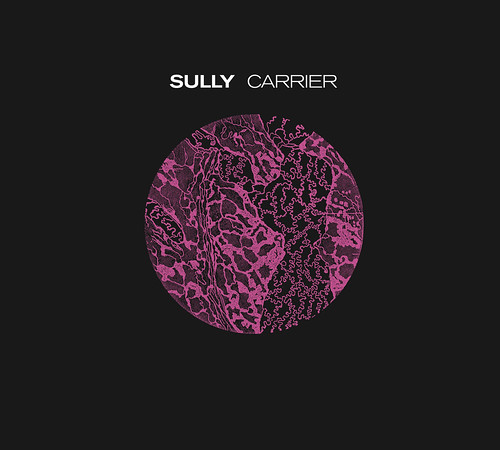
Sully “Carrier” LP showcase

Sully “2Hearts” [Keysound]
Sully “In Some Pattern” [Keysound]
Sully “Let You” [Keysound]
Sully “Encona” [Keysound]
Sully “I Know” [Keysound]
Sully “Scram” [Keysound]

2nd hour 99% Unreleased Keysound mix by Dusk & Blackdown

Logos “Kowloon” [unreleased Keysound]
Dusk & Blackdown ft Farrah “Lonely Moon (Android Heartbreak) [demo version] [unreleased Keysound]
Logos “King Mob VIP” [unreleased Keysound]
Dusk & Blackdown “We Ain’t Beggin’” [unreleased Keysound]
LV & Joshua Idehen “Primary Colours (extended mix)” [Keysound 22N]
Kowton “Looking at You” [unreleased Keysound 25]
Blackdown “Apoptosis” [unreleased Keysound]
Damu “Maths is Fine for Sum” [unreleased Keysound 27]

Visionist “Come In” [unreleased Keysound]
Dusk & Blackdown “untitled” [unreleased Keysound]
Vibezin “A Little Higher” [unreleased Keysound]
Logos “Error 808” [unreleased Keysound]
Damu ft Trim “Ridin the Hype” [unreleased Keysound 27]
Amen Ra “Low Maintenance” [unreleased Keysound]
Double Helix “Rush” [unreleased Keysound]
Dusk “Fraction” [unreleased Keysound 25]
Amen Ra “Akashic Visions” [unreleased Keysound]


PS You can still get our Rinse show from July HERE.

Sunday, August 21, 2011

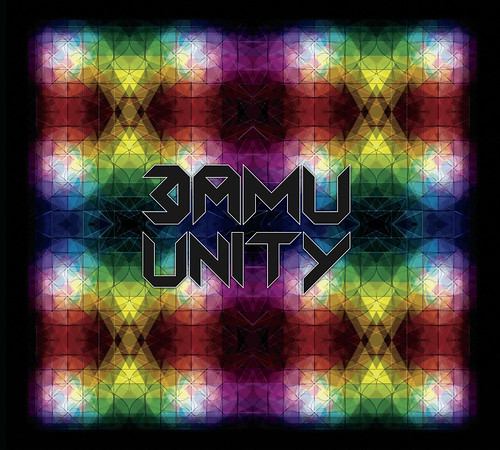
Damu Unity


Damu
"Unity"
Keysound Recordings


Breathless by Damu

Saturday, August 13, 2011

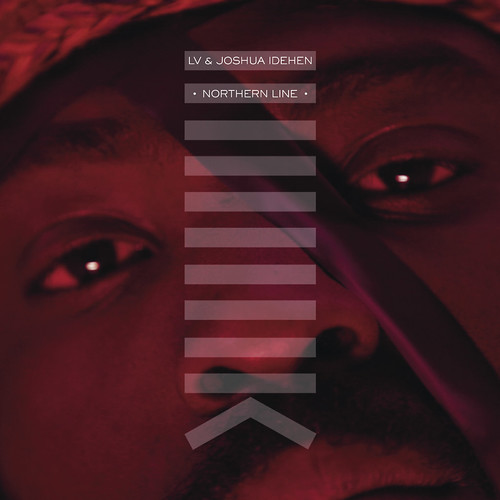
LV and Joshua Idehen "Northern Line"


LV and Joshua Idehen "Northern Line"

- "Northern Line (radio edit)"
- "Primary Colours (Extended remix)"

Keysound Recordings LDN022N

Out digitally September 5th

Locked on?


"I think London pirate radio is generally pretty boring now, tbh. there's still some great DJs and MCs, of course, but bland house and minimal has really taken over, with DJs seeming to see it all as a stepping stone to Pacha or wherever.

There's a lack of energy to most pirate shows now. It's nothing compared to the vibe of 5 or 10 years ago. you now have to be quite careful to pick out a few shows to get anything worth listening to - you used to be able to just switch on the radio at random."


-- Simon Silver Dollar Circle

In a short Dissensus discussion of the role of London’s pirate radio stations during the London riots, this quote from early grime blogger Simon made me think about pirate radio.

The question “is London pirate radio less healthy now than it was 5 years ago?” breaks into two components. Firstly you have to factor in your subjective judgment on how you feel about house. Not UK funky but the kind of international trad house that currently dominates a lot of the pirate shows. Because if you’re not into its sophistication and/or - depending on your viewpoint - blandness, it would stand to reason that you were happier in ’05 when grime was more dominant.

But the other component is the real question here: is the medium – not just the type of music it’s carrying – more or less healthy?

Now I should flag here that obviously I’m a massive pirate radio fan, playing Rinse is the highlight of my month and I’ve been tuning in to Rinse and stations like it (Deja, Raw Mission, Kool, Heat...) for over a decade. But like other medium’s I love, vinyl for example, I know its reach and role is not fixed over time.

I spend quite a lot of time thinking about technology, probably a lot more than this blog lets on, and my base position it is fairly simple: great technology should do a job best. Some people are so into tech and online that they believe in technology for its own sake - but I don’t buy it. If an online version of something works better than a physical version, then I’m in. If it doesn’t, count me out.

So what “job” does pirate radio “do best?” Well, in the last 30 or 40 years, what it’s done is empowered people to get heard who couldn’t get the chance to broadcast via traditional media companies. Mainstream UK broadcasting calls itself “broadcasting” but outside of the BBC, in the music sphere it mostly narrowcasts, using the old model of building a large audience [for advertisers] using the mediocre middle ground. Pirate radio is far more long tail, with large numbers of pirates broadcasting to (in relative terms) a smaller, though not insignificant audience. It was User Generated Content (UGC) broadcasting, long before the term “UGC” was invented. So to answer the question what “job” does pirate radio “do best?,” it gives or indeed gave people a voice when they had few other alternatives.

The thing is, in 2011 people have never had more ways to express themselves, especially musically. Facebook, Twitter, YouTube, Google+, blogs, Sound Cloud, iPhone apps, BB Messenger, file sharing, podcasting, self digital music distribution (Tunecore etc), software for music production – there’s so many this list is incomplete.

I think a good example of this is road rap, south London's variant of hip hop that is like a cousin of grime and has emerged since social media became ubiquitous. Demographically it's exactly like grime and other hardcore continuum variants, except as far as I can see it has no significant club infrastructure nor pirate radio backing.

People take the path of least resistance, especially when it comes to getting heard, so for road rap that's YouTube hood videos or mixtape free downloads on www.ukrapmusic.com. In 2005 the path of least resistance for many people that probably was still pirate radio when it comes to music. But buying and sticking up a transmitter is expensive, hard work, not to mention illegal, and so in 2011 I don’t think pirate radio has a monopoly on self expression with those excluded from mainstream broadcasting anymore. And that’s cool - most medium’s have had their monopolies broken by the internet: ask TV stations, newspapers or book publishers – that’s just how things are in 2011.

Despite all the choices, I still listen to more Rinse podcasts as hours per month of music than anything else. It’s that pirate mentality but broadcast in a 2011 way.

Tuesday, August 09, 2011

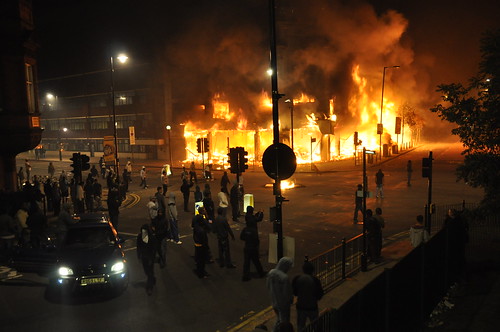
London riots 2011


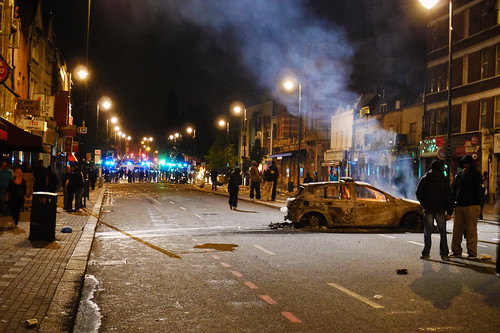
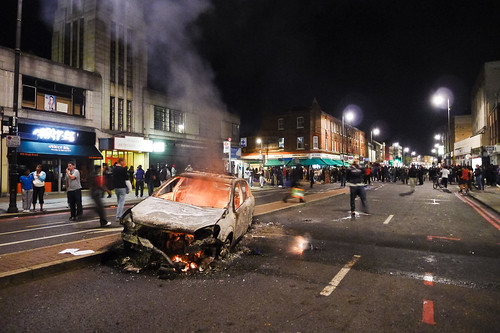
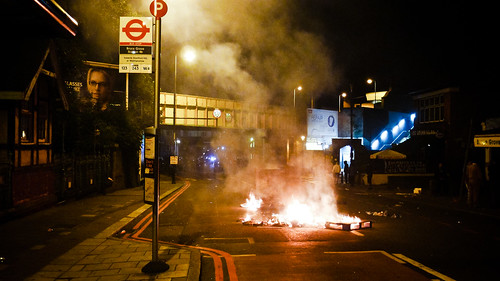
-- Photos of the Totenham Riots by Nico Hogg, full set of shots here.


Nico on taking these shots...

"Most of these were taken up the front, in the no mans land between the mass and the police line protecting Tottenham Police Station, bottles and missiles going everywhere.

It was a very tense environment, a lot of hostility was expressed to people with cameras. Got tangled in a trample of men lashing out against a professional photographer - 15 or so plus some bystanders jeering them on, but others trying to calm it. I had mine snatched from round my neck but managed to get it back... had friends there, don't think a non-local would have been so lucky. to be honest that put me off for a while.

It's pretty difficult to convey exactly how it feels to watch the place you grew up in getting trashed and torced. Still can't really believe it, every time the reality of it sets in another bit of news comes up - those Croydon aerial shots in the news earlier made my jaw fall to the floor. So much tinder in London at the moment."

-- Read more about Nico Hogg's photo's here, here, here and most recently here.


So what do I think about the riots? I can't condone the actions and don't think much positive of it will come about for the communities involved. I feel for the home and shop owners having their posessions randomly destroyed. What did they do to deserve it?

But as for the underlying causes of the anger and tensions, I honestly have thought to myself it's unsurprising it's not happened more often. From my vantage point these riots seem to be about a blend of opportunism and inequality. The former you can never mitigate but I still can't accept why some parts of London have ever been allowed to fall so far. And when people hit rock bottom, there's a bang.

10 years FWD


Zinc 2001
Oris Jay 2002
Hatcha 2003
Slimzee 2004
Youngsta 2005
Skream 2006
Kode 9 2007
N-Type 2008
Marcus Nasty 2009
Oneman 2010
Ben UFO 2011

On the 20th of August at a secret east London location, Rinse FM will be commemorating FWD>>’s tenth birthday. To celebrate, they’re telling the story of the music they have championed through the DJs who have made entire years their own. Eleven influential Rinse DJs will play a selection that takes the assembled headz back in time.

Every DJ on the line up, in one form or another, owes a debt not just to the UK garage scene but to its demise and subsequent fragmentation. And no track had more of a catalytic effect on garage than DJ Zinc’s breakbeat anthem “138 Trek.” It’s tearing breaks upped the ante and energy levels from the warm swing of UKG, opening the floodgates for a torrent of new mutations.

Another pioneer to ride the wave from UKG’s flex to breakbeat garage’s power moves was original FWD>> resident Oris Jay aka producer Darqwan. As the darker side of garage began to develop momentum and a sense of identity at the Velvet Rooms, his anthems like “Confused” and “Said the Spider” upped the levels.

By 2003 dubstep, as it was soon to be named, was adrift from the UKG mothership, its own, distinct entity, an no other DJ in any other year can claim more influence or credit on dubstep than Hatcha in ’03. With an unrepeatable exclusive ownership of dubstep’s A-list producers (Artwork, Skream, Benga, Loefah, Mala and Coki), his dubplate-driven sets at FWD>> are the foundation the entire genre is built upon.

The way original dubsteppers pay the utmost respect for Hatcha, so grime – another dark garage fragment – looks to Slimzee, the grime dubplate don. At raves like Sidewinder or as part of the foundational Pay As U Go Kartel or his SuperSunday sets on Rinse, he’d unleash exclusive 8bar dubs and in part by association, break the freshest MC talent. Ask Dizzee.

If Hatcha laid the foundations for dubstep, by 2005 Youngsta began reengineering its DNA, cutting out unwanted base pairs until it was left raw and skeletal. Through his sets, full of Loefah, Skream and D1 dubs, came the dark halfstep backbone that would become the scene’s default rhythmic template.

From the darkness comes light and 2006 was the year the colour came flooding back into dubstep and with it for the first time large audiences. And no other dubstep track had ever touched so many people nor made so many new fans as Skream’s Youngsta-broken anthem “Midnight Request Line.”

As dubstep began to gain popularity so it’s diversity began to narrow. Long since determined to swim against the tide, FWD’s warm-up-DJ-turned-sonic-and-A&R-visionary, Kode9, would begin to plot a new course. Many would later come to know him as he who found Burial, but his journey was long since underway.

2008 N-Type sets are in many ways the culmination of dubstep’s transformative process that began with Hatcha’s flailing bongos in ’03, Youngsta’s dread halfstep in ’04 and went to new energy extremes with N-Type’s jump up b-lines. The stage was set for the scene’s global domination.

As grime shifted from bubbling MC-hosted dark garage raves to a sonically shocking, artist-dominated performances, the aggression and lyrical assault proved a bridge too far for some, who turned to revival UKG and US house for a sense of groove. From that sprung UK funky and its leading proponent, Marcus NASTY.

Dubstep coalescing around wobbly jump-up basslines had a divisive effect on the scene and soon a part of its fanbase had its head turned by UK funky. A new hybrid began to emerge and with that, a new pioneer. Oneman may have made his name with breathtaking blends of UK garage and ’06 dubstep classics but by 2010 he was looking forwards not backwards.

Taking a parallel path, Ben UFO was also inspired by mid era dubstep, coming to prominence via the Hessle Audio label. But this year his sets have shown the influence that has dominated so much of the current creative thinking: house and its newest variants. Blending new and old vinyl, Ben UFO makes it unclear what decade we’re in. Ultimately past becomes future, the end the beginning in this London musical continuum.

Tuesday, August 02, 2011

Friday, July 22, 2011

Rinse July


Me, Dusk were on Rinse thurs 28th July. AUDIO HERE.

Damu "Unity" [unreleased]
Breton "RDI Girl unit remix" [Hemlock]
General Levy "Heat (Xxxy vs Swing ting refix)" [free download]
J Beatz "Subwoofer" [unreleased]
Walton "Untitled#2" [unreleased]
JTRP "Hypnotise" [unreleased]
LV ft Joshua Idehen "Primary Colours (extended remix)" [forthcoming Keysound]
Pacheko "Waiting For You (Nehuen remix)" [forthcoming]
Eastwood "Oh Yeah" [unreleased]
Presk "Love Again" [forthcoming Ramp]
Eastwood "I Wanna Funk U" [unreleased]
Double Helix "London v Helsinki" [unreleased]
Monique Lewis "Cassanova (Fuzzy Logic remix)" [forthcoming]
Blackwax "Surface" [unreleased]
Visionist "WMID" [unreleased]
Matt IQ "Brick Lane" [unreleased]
Presk "Slick Rick" [forthcoming Ramp]
Geiom feat Terrible Shock "Two Four Six" [unreleased]
Shortstuff "I Am" [forthcoming]
Eastwood "Hard touch" [unreleased]
Zed Bias "Fairplay feat. Jenna G (Zed Bias Old Skool Remix)" [Forthcoming Tru Thoughts]
Woz "Loose" [Black Butter]

Darq E Freaker "Afghan Cherryade" [unreleased]
Faze Miyake "Jump" [forthcoming]
Trim & DOK "Notice Now" [Butterz]
Filthy Beatz "Throw Em Up!! [forthcoming]
Melé "Lego" [unreleased]
Faze Miyake "Blackberry" [forthcoming]
Addison Groove "Bad Things" [unreleased]
S-X "Bricks" [free download]
S-X "Expensive Talk" [free download]
Blackwax "Offkey" [unreleased]
Visionist "Still Awake"[unreleased]
Sepalcure "Love Pressure (XI Remix)" [forthcoming]
Trim "Notice Now (Kid Smpl Remix)" [unreleased]
Ifan Dafydd "No Good" [unreleased]

The full archive is here.

Thursday, July 21, 2011

Monday, July 18, 2011

Tuesday, July 12, 2011

They call him Roska


In late May I spoke to Roska in order to put together the sleeve notes for his Rinse mix CD. This is the transcript. Unlike other DJs I've dealt with, Roska is unfazed by speaking frankly. The result is an insight into the workings of the UK funky scene from one of its most successful artists.

Blackdown: Hey Roska, so where are you?

Roska: Hotel business mate, in Switzerland. DJing in about three hours time. I’m in Bern, that’s the city, literally just round the corner, a basement sort of thing, 400 people. But i don’t remember the name of the club, I’m shit at these things.

B: Too many clubs, too many cities!

R: Pretty much, yeah man.

B: So let’s start with the Rinse CD. How did you approach it?

R: I got asked the end of last year, and I was just working out the tracklist from then. I submitted the tracklist and sourced all the tracks about two months ago. From there on I was working out what I wanted to do. The same way I approached my Essential Mix it was like just getting the tracks that I play out and that I enjoy and that people have heard me play out. It’s not for the “headz that know,” its for the headz that may have heard of me, the headz have heard me out once and here’s a recap.

B: Yeah it’s a tricky one, Jackmaster was talking about it around his Fabric CD, saying how hard it was to play “upfront” when it’s going to take months for it to come out.

R: That’s what I didn’t want to do. I do like exclusivity but in this day and age everything moves so quickly it’s like, what’s the point? You might as well just do things that are current for the time.

B: And maybe then you play the tracks you feel most strongly about, regardless of when they were made or released.

R: I was looking to see if I could take it exclusive and if I did, all that’s going to happen is it’s going to be a shopping cart for the DJ who doesn’t have those tunes. Because that’s how it works: every mix CD thats up on the ‘net, the majority of time people in the scene don’t even listen to it, they just flick through, find the tunes that are good, get the track name and then go out and source it.

I didn’t want that to be the case for my mix CD. It would just be another mix CD, I could just do that and upload it to XLR8R tomorrow. I just wanted to take it and give it that crossover feel. It’s the commercial stuff on there like Katy B and “I Need Air.” So it’s a little bit in between, rather than just being an underground CD.

B: And how did you structure the mix, the arrangement, the flow of it?

R: I sat down and looked at what tracks fit what, in my usual DJ sets I always have DJ tools, vocals and bangers. So I worked around what was a DJ tool and what was not and see where it could fit in the actual mix. So I set it, did a few test runs at home then brought it to the studio and done it. Funnily enough I recorded it once, that was it and I was quite happy with that. And me, I’m not the tightest of mixers and I thought I would have to do it quite a few times but I done it once and I was happy with everything.

B: I suppose if it’s tracks you knew well...

R: ... exactly, exactly that.

B: So talk me through the producers on there, the ones who have been a big part of your set in the last few months.

B: It is my favourite producers on there: from Zinc, Redlight, one off DVA’s label, Shy One. Yeah, it’s my favourite tunes. Most of the tunes there have been part of my set for four to five months and I’ve solidly played them. And I’ve included my own tracks in there and they’re my favourite ones by me, there’s one from 2008 “They Call Me Roska” it’s called, it’s a dubplate but it’s actually Feline VIP. And then obviously “Wot U Talking About remix” right at the end, that’s sorta one of my best remixes that I’ve done to date, and it worked really well.

And the only exclusive I put on there is actually out now, “Citrus (Don’t Get Lemon)” – Mr Tickle. But I’ve had that for over six months. “In the Deep” by T Williams, that’s probably the darkest I went on the whole CD. “The Only Way Is Down”, Marco Del Horno, that’s probably one of my favourite Marco Del Horno tunes. “I Need Love” done well on the urban, Yellow style events.

B: So what does it mean to you to play on Rinse and be part of the Rinse family?

R: It’s weird, it’s like... I’ve been listening to Rinse since it emerged from being a drum & bass station 98.1. And I listened through 100.3, 100.4 to now. It’s like I’ve always been part of Rinse from always being a follower, then to being on the station and representing. To when I used to speak to Geeneus on MSN, then being on the station and doing four shows a week just to be involved.

There’s just a love for the music and you can tell the way that Rinse genuinely love the music, the back office team just want to make good music and they want to represent good music. And I feel like, what ever I do alongside Rinse, my music will always be undiluted. And it’s going to be what I want out of it, but I’ll get the best out of it because I’m part of Rinse. That’s what I feel when I’m around Rinse. I know I’ll be represented properly and I wont have to do something I don’t wanna do in order to be part of that team.

B: It seems to have had a massive effect on your profile, being part of Rinse. It’s really got you out there, and they’ve done that with Katy B but it’s a much harder challenge with a DJ/Producer.

R: With me, I’m always willing to learn something new and so if you check my first productions and then listen to “Sqwalk” or my album, if you listen to the production level you can tell the difference. So just by listening to what Geeneus says or taking little bits of advice, and actually taking it on, that’s what changed me. What I think Rinse like about me is I don’t rely on Rinse, I’m proactive as well. I’m not going to sit there and wait for Rinse to do something for me I’m going to go out there and do it for myself. And then Rinse will help me along the way somehow. Cos anyone can sit there and be a label slave and sit there and expect people to just do things for them but you can get up off your arse and do it for yourself. It just helps you get that much further.

Even the stuff I did last year, Rinse were a big part of it as they put my album out but off the back of that I pushed myself, I made sure my DJ sets were the best I can make them, which enables me to get another booking on top of that. Just being professional as well, it’s all helped.

B: So you’ve written an album, mixed a CD and run a label but the one thing I’ve not seen you do is tackle a grass roots London club night. Have you ever thought about being a promoter?

R: You know what, I done one night alongside Robin from Dirty Canvas and it went really shit and it kinda put me off because he was really half hearted. But I have considered doing it, and once my label’s profile is raised a bit more, I’m gonna get it on board and I’ll be bringing through the people on my label, rather than it being just a Roska night. Since my album to now, the following and levels have definitely risen. I’ve put out two release with one in June and from those I’ve noticed that people are watching the label and watching me, and it easier.

It’s like knowing someone who’s already in there and them bringing you through, so at the moment I feel like I’m that person who’s bringing people through. I just want to bring out good music, I’ve just got the same values as Rinse. And obviously from good music comes good talent. Just bringing talent through that represent the same values that I have.

B: So what do you make of the state of the general house & funky music at the moment? I’d say just ‘uk funky’ but there’s stuff around this tempo like the stuff Circle played or you’d hear at Yellow that doesn’t call itself UK funky...

R: It’s good you know but there’s no general market for it, if you’re a newcomer. House is so big and the umbrella is so massive that it’s like, if you’re coming in to do deep house now, it’s not going to happen because there’s so much people doing it at the moment, you’ll be one of many. So it’s good to listen to and the urban market is representing it but it’s like they’re just fans of the music who make it. But when funky came through and was doing it, that was our own branch our own take on house. For anyone to come through, it was so easy. When I came through I was doing my 9-5, but I was doing it because I wanted to make and release music. It was so easy: I did three releases and everybody knew who I was in that scene. Looking at house now and people that do deep house now and moved from funky, you’re just wasting your time because you’ve gone from being at the front of the queue to being at the back, because no one is going to notice you unless you make some groundbreaking tune that just hits every market in house and everybody looks at you, it’s not going to happen.

B: It’s funny because I remember interviewing Supa D and Geeneus about four years ago and they were saying the same thing. Ie if you compete as house you’ll never establish your own space. But in UK funky you’ve got your own rules and space to work in.

R: Yep, that’s what funky had and funky had it so much that because there were no rules in funky, shit tunes came through, unmastered, so poor in quality they weren’t even mixdown worthy. That’s what happened and if you look at funky now it’s pretty much non existent, because no one wants to call themselves funky and all the DJs that are playing funky that don’t make music, the tunes are a myth because all the fans of the music can’t even by it. All of the labels kinda just fucked off, after 2009 after the skank tunes were all sold out.

B: I think some of the funky guys have been a bit better recently at getting their tunes out to sell. What do you make of people like Ill Blu? Do you think that style of percussive stuff could be bigger?

R: Yeah definitely, everywhere I go in Europe, people talk about Ill Blu. And they talk about Funkystepz and who else? Champion. There’s a little niche market there, they’ve got something going but there’s not enough of it, and there’s not enough coming through, but they can work it.

B: It’s strange, a lot of people want funky to succeed but a lot of things don’t seem right. There’s so little club infrastructure, outside of If bar...

R: You know what it is? Everybody wants to be a leader but no one wants to work together. I’ve been there before: you can ask a load of funky producers that went. When funky was popping in 2009 I done two meetings. I tried to get everybody on board, I had everybody there who was involved with funky, first when it was really small. And then after that it started getting really silly.

Then I done the second meeting and people were complaining about MCs and stuff. It just fell apart. Everybody was saying “yeah lets push more releases out, do this do that” and throwing all ideas out but after that you just kinda realise that it weren’t going to happen. People started complaining “why wasn’t I invited” and shit, and it just got out of hand.

It worked out like people thought I was blocking them out of the scene and stuff and then I thought fuck it and after that, if that’s the case, I’ll just do what I do. That’s why I’m just doing my stuff and not worrying about a scene.

B: Where did you do the meetings?

R: I did one at a bar in Waterloo. Me, Geeneus, Crazy Cousins, Invasion Records, Hard House Banton, Fuzzy Logic... quite a few of us there. This was late 2008, early 2009. And there was another one middle of 2009 and that was when the MCs started jumping on. The other meeting, Sami Sanchez, his dad owned a hotel and he had a conference room, so we just borrowed that. He said we could have it for free.

B: Did the MCs come along and express their point of view?

R: Nah, it was meant to be a producer thing, that’s what it was, what it turned out to be. And the funny thing was it wasn’t even my idea to do the meeting, it just ended up me organising it. And then I took all the flack for it after and took loads of shit for it. Obviously I learnt a big lesson there, not bothering with that. Everybody wanted to be the leader no one wanted to push the scene.

You’ve got things like the Sound of UK Funky three disc compilation, if you listen to those three CDs it doesn’t tell you nothing about funky. It doesn’t tell you where funky started and it doesn’t tell you where funky is going. It’s just a load of tunes. If you listen to the one Rinse brought out you can understand where funky was and where funky is at the moment, because its got a wide range of tunes. And the three DJs that mixed that Ministry of Sound CD, they were the pioneers of the scene. So it shows you how much they knew about the scene.

B: It’s funny, because there’s been a history of these kind of behind closed doors “scene council” meetings over the years, from jungle, garage, grime and now you say UK funky and they seem like they’re super important but I’m not sure I’ve ever seen anyone change anything through them.

R: Nothing changes because what you see in that room is loads of people who just want to control a scene and not really push it forward as a unit. And that’s how it always breaks down. Grime’s at that stage where everybody just wants to be an artist and the actual roots of grime, where it’s at in the underground, there’s not really much there. There’s only really a handful of DJs who are getting the tunes, it’s crazy man. It’s sad as well because I followed grime, I followed dubstep and I followed most genres and you look at them and the only one that seems to have succeeded and is doing well, is dubstep. Drum & bass is always going to be there. That’s why dubstep deserves the commercial success that it’s getting, regardless if people hate it, they’ve got every single aspect of dubstep on lock and it works and it’s a balance.

B: The weird thing is though, you’re an interesting exception because the one thing that dubstep has done is tapped into that global club network, through booking agents etc. A lot of funky DJs haven’t, but you have. People know who you are and you’re in Switzerland as we speak. So it shows it is possible.

R: It is possible but it feels so weird because I feel like I’m the only one doing it. But, I don’t know what I’ve done differently... it’s weird, and I still don’t understand it myself. I still feel shocked when I go out somewhere. I’ve played in front of 20,000 people, do you know what I mean? I still feel like, how did this happen? All I’ve done is made a few tunes out of my own enjoyment, in my own spare time after work and I’m here.

B: Tell me about the way you make tunes because, there’s a sparseness to your tunes that’s different from other funky. We talked about Ill Blu and Funkystepz for example and the thing that unites them for me is really dense layers of drums. But your sound it different to that. How did you get to your sound?

R: I don’t know, it’s weird... like, some people say it’s an unfinished track, but some people won’t. I don’t know. I just sit there and over the last two, three years I’ve started my tracks with a drum pattern. But now I’ve switched it over and I start with a melody. But when I was doing them then I just wanted to do a skippy drum pattern. Anything that was skippy. I’ve spent my years listening to garage and broken beat, listening to house and grime, hip hop. Just listening to those genres of music and making my own thing from everything. That’s all it is really, but simple. I’ve always gone with: keep it simple. If you keep it simple, people understand it more.

B: For me, it sounds like you use a lot of compression or limiting so it means the sounds you do use in your tracks, sound not loud but really confident. So you don’t need more elements over the top.

R: Sometimes I use compression, on the drums. I might use it on the snare. I’ve raised the gain on the bongos and congas, whereas some people would use it just as a bed. I listen to a lot of tribal stuff and keep it as a roller. So I use compression on the snare but not so much on the kick but also try and keep it as raw as possible.

-- Rinse: 15 mixed by Roska is out very soon.

Sunday, July 10, 2011

LDN024 Damu "Ridin" EP


In the primordial soup that is the space often referred to as “130bpm,” there lies a lot of dull debris and dirty detritus. But amidst the scattered grey asteroids lies a small but glittering phuture-star, Damu, the newest signing to bass station Keysound Recordings.

Whereas much that surrounds him is ordinary and unremarkable, Damu’s quadrant is a glittering explosion of hypercolour and kinetic movement, emotive energy and playful pulsations. To enter into its proximity is, in the nicest possible way, to be irradiated by a kind of cosmic glow rays that leaves you fuzzy and warm. The source for this remarkable sound, developed over a relatively short period, is his infectious enthusiasm and unrelenting positivity.

Damu’s quickly picked up some high profile fans, with The Street’s Mike Skinner, when asked to guest edit an entire section of The Guardian, picked him out as a glowing example of hot new talent. Damu’s also attracted plays from Night Slugs DJs and critical acclaim from Fact Mag and XLR8R magazine, with an EP recently out on Local Action.

FACT Magazine’s Tom Lea, a huge supporter of Damu, said: “Obviously I'm biased but Damu is the most promising young producer in the UK for me, and this is some of the best material he's done yet. I suppose they're dance tracks but for me it's more like big, massive pop music full of hooks, colour and emotion."

With Damu now signed to Keysound Recordings, he’s unleashing his new EP. “Ridin,” that sounds like hypergrime grounded by crunk 808 sub drops – Damu once said he wanted to slip a CDr of the track to OutKasts’ Big Boy at a gig. He didn’t: he should have. “Be Free” and “Crystal Gaea” unleash a warm, UK funky-inspired glow. “Karolina’s Magic J” is perhaps one of the oddest beasts in the realm, a trippy, woozy journey into synth-lead psychedelia.

Damu's "Ridin" EP is out August 8th on Keysound )12" and digital)

Wednesday, July 06, 2011